
Published: 02/07/2025 By Cavender Estate Agent
During this difficult time, granting probate does require a complete picture of the deceased’s estate, and their property often represents their largest single asset. An accurate valuation will make sure that your Inheritance Tax (IHT) return is correct, that HMRC cannot challenge the figures, and that all beneficiaries receive a fair distribution. This guide explains when a free estate-agent valuation suffices, when you need a formal RICS valuation, and how Cavender Estate Agent Guildford Surrey can help guide you through the process.What Is a Probate Valuation?
A probate valuation establishes the open-market value of property at the date of death. It underpins:- Grant of Probate application – HM Courts and Tribunals Service requires estate totals before issuing legal authority to deal with assets.
- Inheritance Tax return – HMRC sets IHT liability based on gross estate value, minus debts and reliefs.
- Capital Gains Tax basis – If beneficiaries later sell, the probate valuation becomes their acquisition cost for CGT calculations.
Market Appraisal vs Official (RICS) Valuation
Purpose
Feature | Free Estate-Agent Market Appraisal | RICS-Registered “Red Book” Valuation |
Purpose | Marketing guidance; sets asking price | Legal evidence of open-market value at death |
Methodology | Based on recent local listings and agent expertise | Formal report using at least three comparables |
Cost | Complimentary | Typically £250–£600 |
Acceptability for Probate | Informal; HMRC may accept if well-documented | Fully compliant; strongest defence against DVS |
Use Case | Initial sale planning, rough estate estimates | Mandatory for estates over IHT threshold or where accuracy is critical |
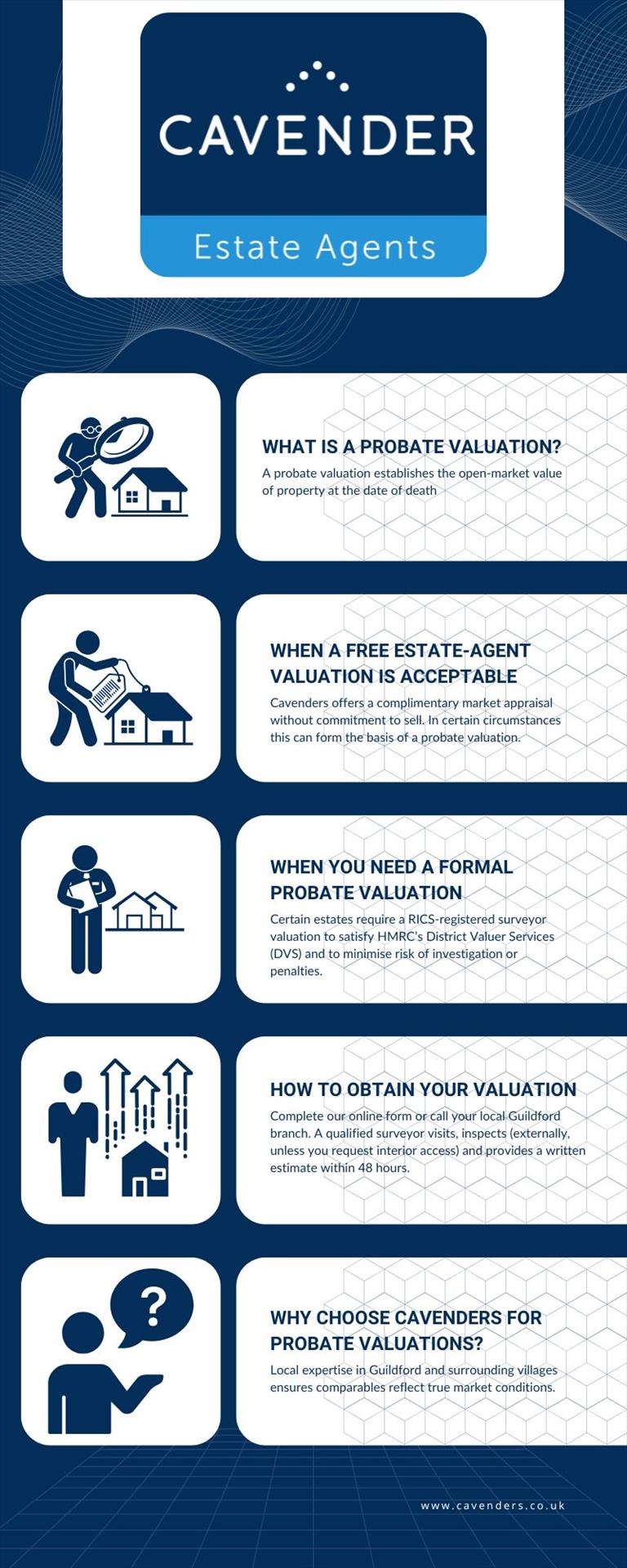
When a Free Estate-Agent Valuation Is Acceptable
Cavender offers a complimentary market appraisal without commitment to sell. In certain circumstances this can form the basis of a probate valuation:- Small estates – Total estate under approximately £325,000 with no IHT due.
- Spouse transfers – Entire estate passes to a surviving spouse or civil partner; no IHT arises.
- No foreseeable HMRC scrutiny – If estate assets are straightforward and well within nil-rate bands.
- Obtain at least three independent agent valuations (including Cavender) within a narrow timeframe.
- Document comparables – Report addresses, sale prices, sale dates and property details.
- Average the figures to approximate a defensible open-market value.
When You Need a Formal Probate Valuation
Certain estates require a RICS-registered surveyor valuation to satisfy HMRC’s District Valuer Services (DVS) and to minimise risk of investigation or penalties:- Estate value exceeds the nil-rate band (£325,000 as at July 2025).
- Complex assets – Unusual properties, extensive grounds or mixed-use premises.
- High-value items – Antique collections, fine art or bespoke fixtures valued over £1,500 individually.
- Anticipated sale price volatility – Market downturns or rural locations with limited comparables.
- A formal statement of open-market value at the date of death.
- Three or more suitably comparable properties analysed in depth.
- Full methodology and rationale, aligning with HMRC guidelines.
How to Obtain Your Valuation
- Free Cavender Market Appraisal
- Complete our online form or call your local Guildford branch.
- A qualified surveyor visits, inspects (externally, unless you request interior access) and provides a written estimate within 48 hours.
- Multiple Agent Average
- Contact at least two further local agents for valuations close to the date of death.
- Ensure all agents use a consistent “open-market value” definition.
- Compile comparables into a spreadsheet to calculate the average.
- RICS-Registered Surveyor Instruction
- Cavender can recommend chartered surveyors experienced in probate.
- Surveyor conducts internal inspection (if required), researches three comparables, prepares a compliant “Red Book” report.
- Typical turnaround: 7–14 days.
- Self-Arrange Specialist Valuations
- Vehicles: Red Book car specialist or online tools.
- Jewellery and art: Independent valuers accredited by recognised bodies (e.g. Institute of Registered Valuers).
Cost and Timeframe
Service | Cost Range (Approx.) | Expected Timeline |
Cavender free market appraisal | £0 | 1–2 business days |
Additional agent valuations (per agent) | £0–£50 | 2–5 business days each |
RICS “Red Book” surveyor report | £250–£600 | 7–14 calendar days |
Specialist asset valuations | £100–£300 per item | 3–7 business days per item |
Presence at Inspection
You do not usually need to be present for external valuation; an internal inspection may require access but can be arranged around executors’ schedules.
Risks and “What If…” Scenarios
What happens if a probate valuation is wrong?- HMRC’s DVS can reassess values and levy penalties on under-valuations deemed negligent.
- Over-valuation does not incur penalties but may delay sale and incur higher initial IHT payments (refundable later upon rectification).
- Beneficiaries may dispute distribution ratios if property under-performs.
- Documented comparables and a formal RICS report protect executors against claims.
- Executors can apply for IHT repayment on overpaid tax if HMRC accepts revised post-sale valuation.
- Retain all written appraisals, comparables data and surveyor methodology.
- Include photographs, floor plans and local sales evidence.
- Submit complete evidence pack with IHT400 return to minimise DVS queries.
Probate Application Essentials
To apply for probate you must supply:- Death certificate
- Original will (if available) or Grant of Letters of Administration details
- Estate inventory – List each asset and its valuation
- Debts and liabilities – Outstanding mortgages, loans, funeral expenses
- IHT400 and IHT421 – Tax forms, depending on whether IHT is payable
- Professional valuation reports – RICS Red Book, specialist asset valuations where required
Why Choose Cavender for Probate Valuations?
- Local expertise in Guildford and surrounding villages ensures comparables reflect true market conditions.
- No-obligation free market appraisals get you started without cost.
- Trusted recommendations for chartered RICS surveyors when formal probate valuations are necessary.
- Holistic probate support – access to guides for executors, IHT calculators, and mortgage advice through our branches.
- Transparent process – clear communication at every stage, with written reports detailing methodology.